

Quick Summary: Your Rights if ICE Comes to Your Home
- Do not open the door—and make sure your children know not to open it. ICE cannot enter your home without a valid judicial warrant signed by a judge (not an immigration judge). Most ICE forms (I-200 or I-250) are not judicial warrants and do not allow entry without your permission.
- Ask them to slide the warrant under the door or hold it up to a window. If it is not signed by a judge or magistrate judge and/or does not clearly name the person or areas to be searched, say: “I do not consent to entry.”
- If officers enter anyway, do not physically resist, but clearly state you do not consent and exercise your right to remain silent. Ask to speak with an attorney and do not lie.
- If you are taken to an ICE facility, you can dial 2150# to speak to the American Bar Association’s Detention & Legal Information Hotline or dial 9233# to speak to the National Immigration Detention Hotline. Memorize these numbers before you encounter ICE.
Understanding this difference can help you protect your rights, your family, and your home.
For many immigrants and mixed-status families, an unexpected knock on the door can create fear and confusion. Knowing your rights, and understanding the difference between different types of warrants, can help you respond calmly and appropriately.
This article explains what a warrant is, why it matters, and what to do if immigration authorities come to your home.
This article provides general information, not legal advice. Every situation is different. If you have questions about your specific case, it is important to speak with an immigration attorney.
What Is a Warrant?
A warrant is an official written document issued by a court or government agency. It authorizes law enforcement to take specific action, such as:
- Arresting a person
- Searching a property
- Seizing certain items
The Fourth Amendment of the U.S. Constitution protects individuals – including documented and undocumented immigrants – from unreasonable searches and seizures. In most situations, law enforcement officers must have a valid warrant to enter someone’s home without permission.
There are limited exceptions to this rule. However, this article focuses only on situations where no exception applies—such as when officers come to your home and request entry without urgent or emergency circumstances.
Understanding whether a warrant is valid and what type it is can make an important difference in how you should react to the situation.
The Three Types of Warrants You Should Know About
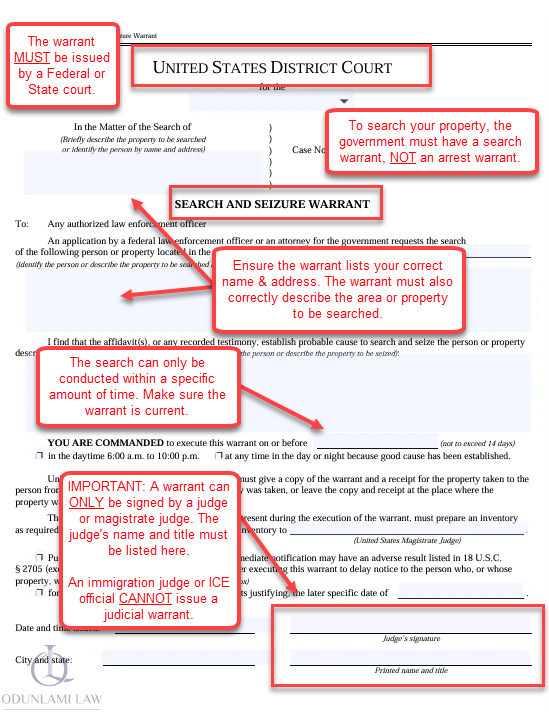
1. Judicial Warrant
Click to view image at full size.
A judicial warrant is issued by a court and signed by a judge or magistrate (not an immigration judge).
To obtain this type of warrant, law enforcement must show “probable cause”—a reasonable belief that a crime has occurred.
A valid judicial warrant will:
- Be issued by a court (such as a U.S. District Court or a New Jersey state court)
- Be signed by a judge or magistrate judge
- Clearly name the person to be arrested (for an arrest warrant), and/or
- Clearly describe the specific property or areas to be searched
If officers have a valid judicial warrant that authorizes entry into your home, they may legally enter, even without your consent.
2. Administrative or Immigration Warrant
Click to view images at full size.
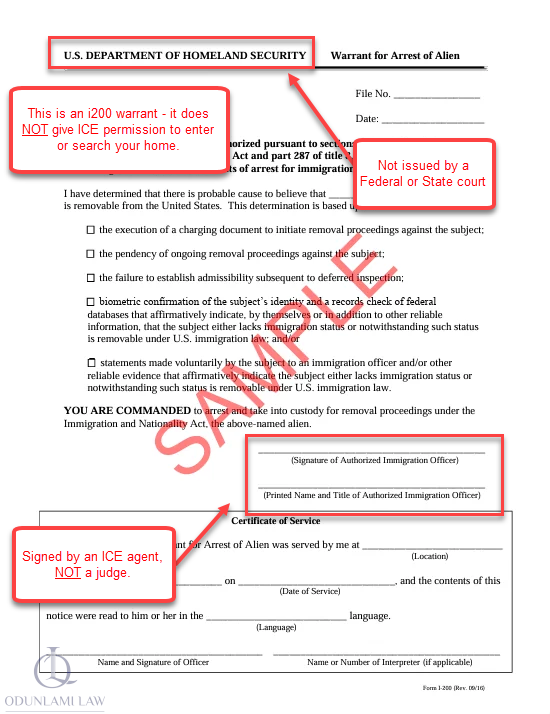
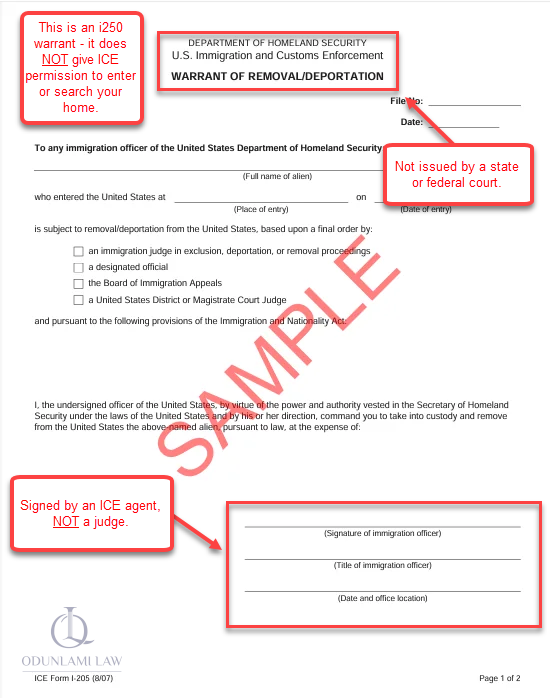
An administrative warrant, also known as an immigration warrant, is issued by a federal agency such as Immigration and Customs Enforcement (ICE) or Customs and Border Protection (CBP).
These are typically:
- Form I-200 (Warrant for Arrest of Alien)
- Form I-205 (Warrant of Removal/Deportation)
These forms are signed by immigration officers—not by a judge. This distinction is very important.
An administrative (ICE) warrant:
- Does not authorize officers to enter a private home without consent
- Does not require a judge’s signature
- May allow an arrest in public
- May allow an arrest inside a private space only if officers are lawfully permitted to enter (for example, if someone consents)
If ICE presents only an I-200 or I-205 form, it does not give them the legal authority to enter your home without your permission.
3. Blackie’s Warrant
A Blackie’s warrant is a civil search warrant signed by a judge or magistrate. It is named after a court case called Blackie’s House of Beef v. Castillo.
These warrants are typically used in worksite enforcement actions.
Unlike a criminal warrant, officers do not have to show probable cause that a crime occurred. Instead, they must show probable cause (a reasonable belief) that someone at a specific worksite may not have lawful immigration status.
A Blackie’s warrant:
- Must be signed by a judge or magistrate
- Must describe the specific place to be searched
- Is generally used for worksites—not private homes
What to Do If ICE Comes to Your Home
Preparation is important. Families should talk in advance about what to do. Make sure everyone in your household—including children—understands that they should not open the door for immigration officers.
If ICE or other immigration authorities come to your home:
1. Stay Calm and Do Not Open the Door
You are not required to open the door just because officers knock.
Do not open the door to “talk.” Do not step outside. Do not even partially open the door as that may be interpreted as giving consent for the officers to enter.
2. Ask What They Want — Through the Door
You can speak through the closed door, a window, or a doorbell camera.
You may ask:
- “How can I help you?”
- “Do you have a judicial warrant signed by a judge?”
If safe to do so, record the interaction. Focus on recording your own behavior and the officers’ statements. Do not interfere with their actions.
3. Ask to See the Warrant — Without Opening the Door
If they say they have a warrant, ask them to:
- Slide it under the door, or
- Hold it up to a window or camera
Do not open the door to receive it.
Review it carefully. A valid judicial warrant must:
- Be signed by a judge or magistrate (not an immigration judge or ICE officer)
- Come from a state or federal court
- Clearly name the person to be arrested and/or describe the specific areas to be searched
If the document is an I-200, I-205, or another form signed only by an ICE officer, you may say:
“I do not consent to entry.”
4. Do Not Give Consent
Do not:
- Open the door, even partially
- Step outside to talk
- Invite officers in
- Say “okay” or “sure”
Any of these actions may be considered consent. Once consent is given, officers may not need a warrant to enter.
If you feel pressured, calmly repeat:
“I do not consent to entry.”
“Please leave.”
5. If Officers Enter Without Permission
Do not physically resist. Physical resistance can lead to criminal charges.
However, clearly state:
“I do not consent to this entry.”
“I do not consent to this search.”
If they begin asking questions:
You have the right to remain silent. Remaining silent is not being uncooperative, it is your legal right.
You may also say:
“I choose to remain silent.”
“I am exercising my right to remain silent.”
If you do speak, do not lie. Providing false information can negatively affect your case.
6. If You Are Detained
Remain silent. Tell others in your home to remain silent.
Ask to speak with an attorney.
If you are taken to an ICE detention facility and do not have an attorney’s phone number, you may dial:
- 2150# — American Bar Association’s Detention & Legal Information Line
- 9233# — National Immigration Detention Hotline (Freedom for Immigrants)
These hotlines do not provide direct legal representation, but they may help connect you with legal resources.
Knowledge Is Power
Understanding the difference between a judicial warrant and an immigration warrant can make a critical difference in protecting your rights.
For many families, preparation brings peace of mind. Having a plan, educating your children, and knowing what to say—and what not to say—can help you respond calmly during a stressful situation.
If you have concerns about your immigration status, an outstanding order, or how enforcement activity could affect your family, it is important to seek individualized legal guidance. Speaking with an immigration attorney can help you understand your options and prepare for the future with confidence.
At Odunlami Law, we are committed to providing compassionate, personalized guidance to individuals and families navigating complex immigration matters. If you would like to discuss your situation, we invite you to contact our office to schedule a confidential consultation.